
Reviewed · BUDA CASTLE & FISHERMAN'S BASTION
Gems of the Budapest Castle District Walking Tour
Two hours, one big hill of stories. This Budapest Castle District walking tour strings together symbols, legends, and quick photo moments across some of the area’s most famous corners, with a live English guide and an easy pace that still packs a lot in. I also love the built-in rhythm: short stops, then enough time at places like Fisherman’s Bastion to get your bearings fast and grab Pest views.
You do a lot of walking on uneven terrain, and many stops are brief (often around 5 minutes). If you want slow museum-style exploring, this may feel rushed. Still, at just $3.61 with a guide and no separate site admission listed, it’s one of the best ways to understand the Castle District without burning a whole day.
In This Review
- Key highlights I’d plan around
- Budapest Castle District, condensed: how this 2-hour walk really works
- Holy Trinity Statue: reading the column like a story
- Matthias Church outside: foundation context and architectural details you can spot
- Fisherman’s Bastion: double-cross symbolism and big Pest views
- Pope Innocent XI, Sylvester II, and power statues in the courtyard air
- National Archives of Hungary: Vienna Gate and the “Golden signatures” effect
- Saint Mary Magdalene: the coronation-mantle monument and WWII ruins
- Arpad Toth Promenade (Setany): flags, cannons, and siege-era memory
- Mounted Andras Hadik and the sweet side of local history
- The Labyrinth: a dungeon walk that links to Dracula/Vlad the Impaler
- Independence War statue: 1848 revolution symbolism and the Houdini connection
- Szent György Street and the medieval ruins you can’t miss after hearing the key
- Buda Hill Funicular: a zero-kilometer moment plus the oldest bridge tie-in
- Turul Bird and King Matthias’s fountain: the fun myths and romance-tragedy mood
- Lions Court, Royal Riding Hall, and Prince Eugene’s equestrian statue
- Maria Mater Dei and Castle Garden: bridges, spiral steps, and Triton
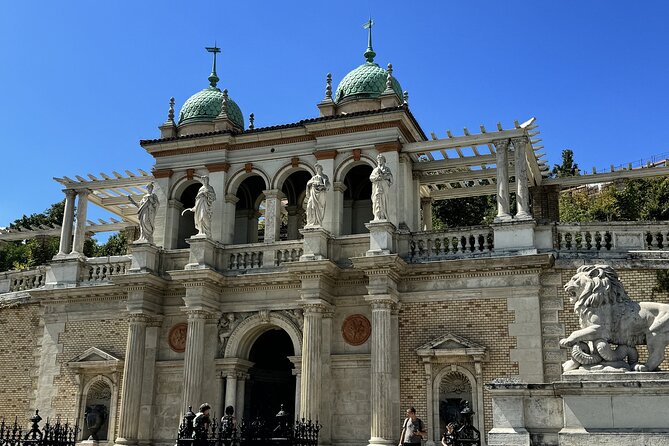
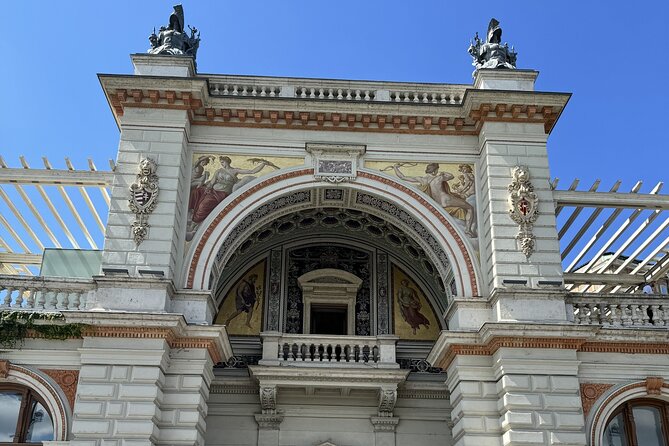
- Castle Garden Bazaar: Várkert Bazár architecture and facade statues
- Price and value: why $3.61 can work (and when it won’t)
- Who this tour suits best
- Should you book the Gems of the Budapest Castle District Walking Tour?
- FAQ
- How long is the Gems of the Budapest Castle District Walking Tour?
- Where does the tour start and where does it end?
- Is the tour offered in English?
- Are there admission fees at the stops?
- How large are the groups?
- What should I do if the weather is bad?
Key highlights I’d plan around
- Holy Trinity Column symbolism explained figure by figure, so the statue doesn’t stay a statue
- Matthias Church context right at the foundation story level, plus architectural details you can actually notice
- Fisherman’s Bastion Pest panorama paired with legends and the double cross story
- Labyrinth dungeon vibes plus Dracula/Vlad-the-Impaler storytelling underground
- Buda Hill Funicular stop with the second-oldest funicular and the zero kilometer stone moment
- Castle complex highlights from the Lions Court to the Royal Riding Hall and Prince Eugene’s equestrian statue
More of Castle Hill, turrets and the river below
- Budapest: Buda Castle Cave Tour★ 4.7 · 5,677 reviews
- Budapest: Buda Castle District Vampires and Myths Night Tour★ 4.6 · 3,830 reviews
- Budapest: Buda Castle Walk with Saint Stephen’s Hall★ 4.5 · 3,012 reviews
- Budapest: Buda Castle District Walking Tour★ 4.6 · 2,108 reviews
Budapest Castle District, condensed: how this 2-hour walk really works
This is a 2 hours 10 minutes walking tour that starts at the Holy Trinity Statue (Szentháromság u., 1014) at 3:00 pm and ends at the Castle Garden Bazaar by the Várkert Bazár area (Ybl Miklós tér 2-6, 1013). The group is capped at 45 travelers, which matters here because you’re moving constantly and you’ll want to hear the guide clearly at each stop.
Pricing is unusual in a good way: $3.61 per person. That’s not a typo in spirit—part of the value comes from the fact that the tour’s featured sights are marked as ticket-free to view at each stop. You’re not paying extra entrance fees at the main points, so your money goes toward having someone point out what to look for.
One small practical note: you’ll spend a lot of time outdoors or at exterior viewpoints. Wear shoes you trust. Even when a stop is only 5 minutes, you’re still standing on cobbles and hills.
Holy Trinity Statue: reading the column like a story
You begin with the Holy Trinity Statue, starting in the part of Budapest Castle District where history feels stacked—literally in stone. The guide gives background on the construction of the Holy Trinity column and then helps you read the symbolism of the figures. This is the kind of start that pays off later: once you understand how the guide interprets monuments, the next stops become much easier to follow.
What I like about this first stop is that it’s not just name-dropping. You’re nudged toward paying attention—how the figures relate, what their symbolism is meant to convey, and why the column is worth more than a quick photo. Even if you’re not usually into religious art, the way the guide explains it makes the column feel like a message, not decoration.
Matthias Church outside: foundation context and architectural details you can spot
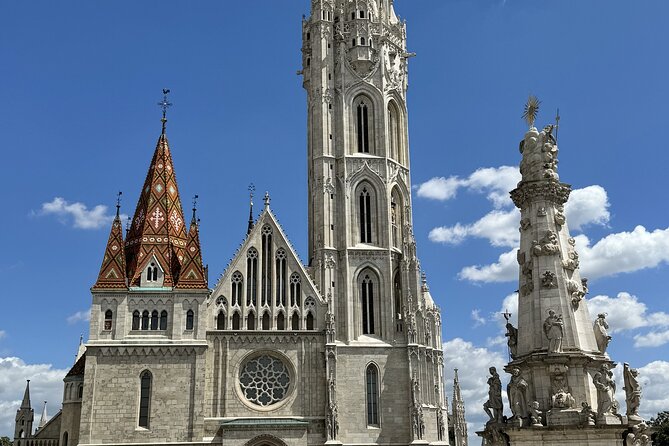
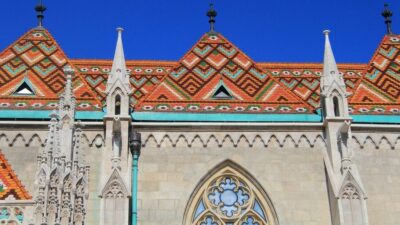
From the column, you move straight to Matthias Church, spending a short window learning about the foundation story and the architectural details. The tour doesn’t ask you to treat it like a background postcard. Instead, you’re guided to notice features right where you’re standing.
A drawback to keep in mind: the stop is brief. So if you prefer to linger for 20–30 minutes per landmark, you’ll need to come back later on your own. The trade-off is that the tour keeps momentum and keeps building a picture of how the Castle District’s religious and political symbols connect.
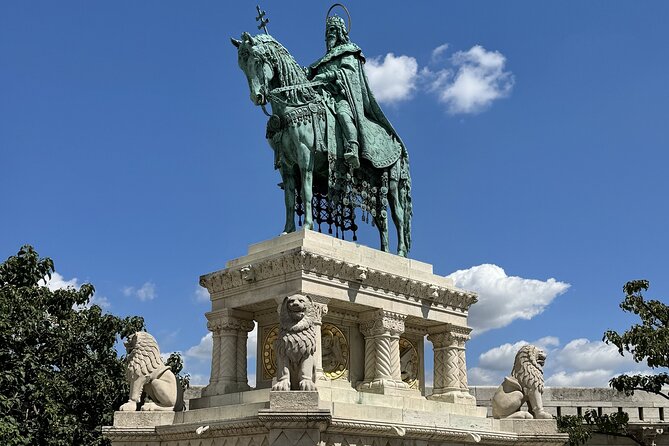
Fisherman’s Bastion: double-cross symbolism and big Pest views
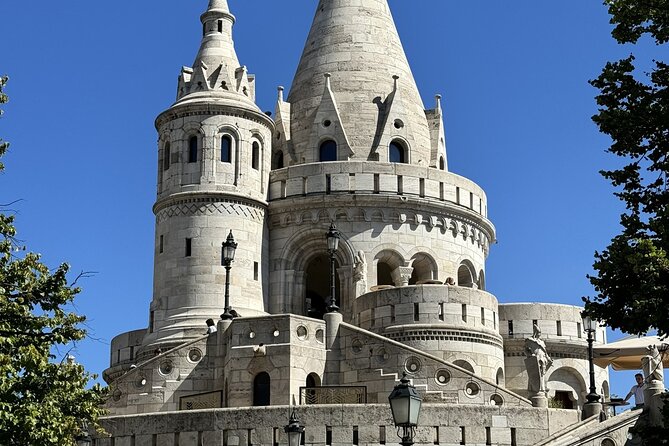
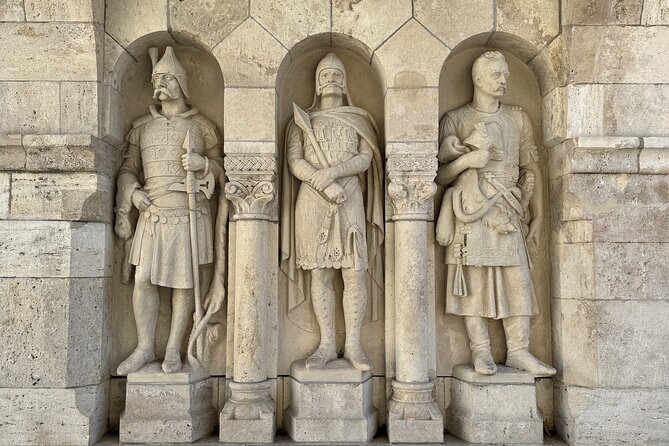
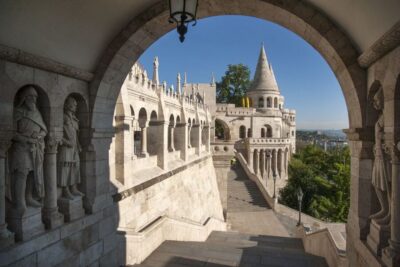
Then you hit the moment most people come for: Fisherman’s Bastion. You’ll get help interpreting the statues here and, importantly, a guided look at the relation of the double cross and Hungarian identity. This is the kind of explanation that turns a scenic overlook into something you actually understand.
You also get time for the view. The tour sets aside around 20 minutes here, with room for a short break and photos. That’s a smart length of time—enough to shoot from different angles and still hear the guide’s legends without rushing your own looking.
Legends come up too, and the guide’s approach is practical: you’re not stuck with dry dates. You walk away knowing why people talk about these statues and why the viewpoint became a stage for memory.
Budapest at street level, more routes on foot

Pope Innocent XI, Sylvester II, and power statues in the courtyard air
Next comes the Statue of Pope Innocent XI, with a tight set of references that help connect church authority and royal legitimacy in Hungarian storytelling. You’ll see the statue’s relationship to Pope Sylvester II and also hear about the coronation statue of King Matthias.
One detail mentioned in the tour notes really helps this stop click: the area is tied to the oldest building of Hungary. Even without doing a deep, inside-the-building visit, the guide’s framing makes this part of the walk feel like you’re standing near the roots of later power and culture.
This is also a good moment to slow down mentally. You’ll start to recognize how often symbols repeat across the district—crosses, kingship, and faith showing up again and again.
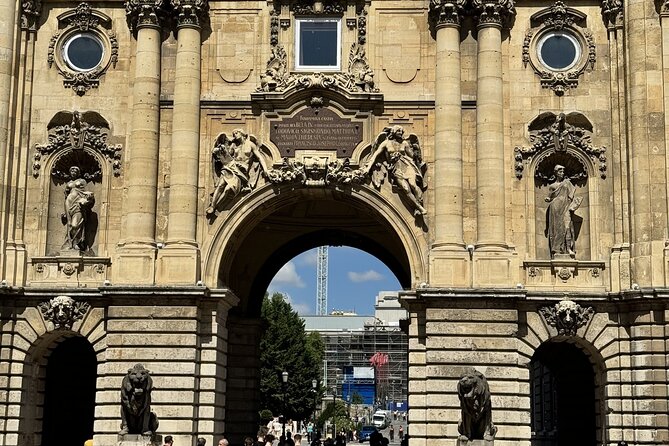
National Archives of Hungary: Vienna Gate and the “Golden signatures” effect
At the National Archives of Hungary, the guide shifts toward architecture and specific nearby details. You’ll hear about the Vienna Gate and notice the Golden signatures by Uri Street, along with statues nearby and the tales tied to them.
Why this stop is worth your attention: archives sound like paperwork, but architecture around them often acts like a public gallery. The guide helps you see the building as a civic statement, not just a place you might pass by on your way to the views.
The stop is short (about 5 minutes), but it’s dense. If you love photo opportunities with meaning—rather than just pretty facades—this one will feel like a win.
Saint Mary Magdalene: the coronation-mantle monument and WWII ruins
The next stop is the Church of Saint Mary Magdalene, with attention on the monument of the coronation mantle of the Hungarian kings. You also hear about WW2 ruins nearby, so the tone shifts from ceremonial to lived trauma.
The practical takeaway: this is where the Castle District stops being only about kings and starts reminding you that Hungary went through hard years. Even when you’re only there briefly, the guide helps you connect the symbolism of coronation artifacts to what the city endured later.
Arpad Toth Promenade (Setany): flags, cannons, and siege-era memory
The tour moves to Arpad Toth Promenade (Setany), and this stop is built for storytelling. You’ll learn about the first flag after WWII and see the row of cannons. There’s also a view out toward the Buda hills, plus a statue of Szekely Knight.
What you get here is a “remember the siege” context tied directly to the physical setting. It’s not abstract. The guide gives a brief WWII and siege of Budapest storyline that makes sense of why the area feels staged for remembrance.
This stop lasts about 10 minutes, which is enough to take in the sights and still hear the war story without feeling like it’s swallowing the rest of your day.
Mounted Andras Hadik and the sweet side of local history
You’ll then stop at the Statue of Mounted Andras Hadik, described as the most famous Hungarian knight in this storytelling. The guide also brings in interesting local trends and notes the oldest Hungarian confectionery connected to the area.
This is a nice palate cleanser after heavy history stops. You’re still learning, but the mood becomes lighter. If you’re the type who enjoys travel days that mix serious monuments with small cultural details, this stop fits your style.
The Labyrinth: a dungeon walk that links to Dracula/Vlad the Impaler
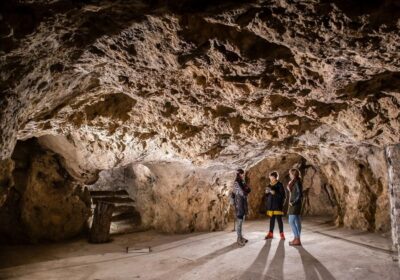
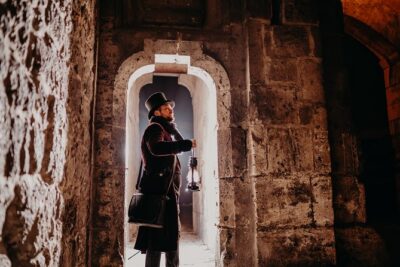
Next is the Labyrinth, described as a natural cave that was used as a dungeon. Here, the guide ties the setting to the Dracula / Vlad the Impaler story.
Even if you’ve heard Dracula before, this kind of location-based storytelling tends to work better than reading alone. The guide gives you a way to imagine how a cave could carry fear and legend. It’s also a good mid-tour break: about 10 minutes here lets you shift from hilltop views to a darker, more theatrical mood.
Independence War statue: 1848 revolution symbolism and the Houdini connection
The tour’s next stop focuses on the Statue of the Independence War, with background on the Hungarian revolution of 1848. The guide connects the statue’s symbolism back to the original war, so you don’t leave only with a label—you understand the intended message.
You also hear about the House of Houdini nearby. This is one of those “small detour” facts that makes a walk feel alive. Instead of every stop being the same tone, you get a different kind of story, still tied to Hungarian identity and memory.
This stop is short (about 5 minutes), but it’s a memorable pivot point.
Szent György Street and the medieval ruins you can’t miss after hearing the key
At Szent György Street, the guide points out offices of the president and prime ministers and then brings you to ruins of medieval castles. You get secret-story flavor here—short, quick narratives that don’t require you to be a Hungary expert.
The value is in the setup. Once you hear what to look for, the area becomes more than a corridor: it turns into a timeline in buildings, offices, and ruined stone.
Again, this is around 5 minutes, so keep your eyes up and don’t wait for the guide to walk you through everything. You’ll want to actively look.
Buda Hill Funicular: a zero-kilometer moment plus the oldest bridge tie-in
Next is the Buda Hill Funicular stop, framed as the second oldest funicular. You also get the zero kilometer stone moment and mention the oldest bridge of Hungary connected to the route.
This is a great stop for practical travelers, because it anchors “what you’re seeing” to real geography and transit history. Even if you don’t ride anything in this tour, you understand where the city places its major connections.
Stop time is about 5 minutes, but it’s one of the most “useful for later” segments. You’ll recognize the district layout better as you keep walking.
Turul Bird and King Matthias’s fountain: the fun myths and romance-tragedy mood
You’ll see the Turul Bird Statue, explained as the national bird of Hungary, with background on the storyline tied to the naming of the Hungarians. It’s myth and identity in statue form, and the guide keeps it simple enough to follow while you’re still moving uphill.
Then you reach the Fountain of King Matthias, described as the prettiest fountain of Budapest with a romantic-tragedy story attached. This is one of the few stops where the tone becomes more emotional. The fountain itself is the visual reward, while the story makes it more than a pretty pause.
Those are both short stops (around 5 minutes), but the guide’s linking theme—symbol plus story—keeps them from feeling random.
Lions Court, Royal Riding Hall, and Prince Eugene’s equestrian statue
Now you’re in the heart of the castle feel: Lions Court – Buda Castle. You’ll look at the courtyard and hear explanations about mythical statues on the facade. This is a satisfying step because you’re not just outside looking in—you’re in a space designed for drama and symmetry.
After that comes the Royal Riding Hall, presented as the royal Hungarian stable. The guide adds interesting local trends to keep the stable story from feeling purely technical. This stop is brief (about 2 minutes), but if you pay attention, you’ll get the shape of the place and why it mattered.
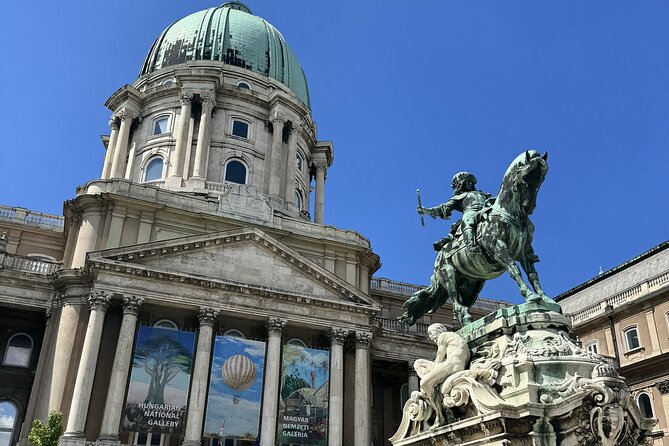
Finally, Prince Eugene of Savoy’s equestrian statue appears. It’s described as the biggest statue of the castle district and connected to him being a liberator of Hungarians from the Ottomans, with fun facts along the way. This is a “big presence” moment: the scale helps you feel the history rather than only hear it.
Maria Mater Dei and Castle Garden: bridges, spiral steps, and Triton
The walk continues to S. Maria Mater Dei, featuring the statue of Virgin Mary and baby Jesus. You’ll also hear about bridges of Budapest and how they relate to Hungarian monarchs. That bridge connection is a clever trick: it reminds you you’re not stuck on one hill. This district ties into the whole city.
Then you reach Castle Garden. You’ll get highlights like the spiral staircase tower and the Triton fountain. The garden stop is around 5 minutes, so you’re not going to explore every path—but you’ll come away with a clear sense of where to return if you want more quiet time.
Castle Garden Bazaar: Várkert Bazár architecture and facade statues
The tour finishes at Castle Garden Bazaar, where the focus is architecture of the Várkert Bazar and the statues on the facade. The wrap-up is only about 5 minutes, but it lands well because the area is visually rich and right near your end point.
If you want a simple plan for after the tour: once you’re done, you can keep wandering around the bazaar area on your own while the stories are still fresh in your head.
Price and value: why $3.61 can work (and when it won’t)
Let’s talk money, because this tour’s price is so low that it raises a fair question: what are you really paying for?
You’re paying for a live guide, and the tour is built around sights that don’t require separate admission fees (each stop is marked ticket-free). So you’re not stacking costs on top of what you already paid for the walk. You’re also getting lots of interpretive storytelling—symbols, legends, and links between monuments and Hungarian identity.
This value works best if you:
- like seeing meaning behind statues and architecture
- want a guided route through the Castle District rather than a self-made puzzle
- enjoy photo breaks but still want context before and after
It might not work if you:
- want long indoor time at churches or museums
- hate brisk pacing on hills
- need a lot of downtime between stops
Who this tour suits best
This is a strong fit for first-timers in Budapest who want the Castle District story in one afternoon. It’s also a good choice for travelers who don’t want to plan a route and still want to leave with something more than postcard pictures.
If you’re traveling with kids, it can work too, because the guide includes legends and Dracula-linked cave storytelling. Just know it’s a walking-focused format with short stops.
Should you book the Gems of the Budapest Castle District Walking Tour?
If you want a clear, story-driven introduction to the Castle District, I’d book it. The guide-led approach to symbols (Holy Trinity column, double cross storytelling, Turul bird, coronation-related monuments) turns “famous landmarks” into “understandable landmarks.” And with a live English guide, ticket-free sightseeing stops, and a route that ends right where you’ll likely want to wander next, the practical value is hard to beat.
Book it with the right expectation: this is a fast, outdoor-heavy walking tour. If you love slow and detailed museum time, plan to return to your favorite spot on another day.
FAQ
How long is the Gems of the Budapest Castle District Walking Tour?
The tour is approximately 2 hours 10 minutes.
Where does the tour start and where does it end?
It starts at the Holy Trinity Statue (Szentháromság u., 1014) and ends at the Castle Garden Bazaar near Várkert Bazar (Ybl Miklós tér 2-6, 1013).
Is the tour offered in English?
Yes, the tour is offered in English, and you receive a mobile ticket.
Are there admission fees at the stops?
The stops listed are marked as admission ticket free, so you are not adding separate entrance costs for the featured sights.
How large are the groups?
The experience has a maximum of 45 travelers.
What should I do if the weather is bad?
This experience requires good weather. If it’s canceled due to poor weather, you’ll be offered a different date or a full refund.
More Tour Reviews in Budapest






More of Budapest, Step by Step






More of Castle Hill



Just Added: More Budapest Reviews
- Sightseeing flight over Budapest
★ 5.0 · 3 reviews - Budapest: Walking Tour with Chimney Cake & Polaroid Photos
★ 5.0 · 3 reviews - Self Guided Tour In Budapest With 100 Captivating Audio Stories
★ 5.0 · 3 reviews - Budapest Art Nouveau Walking Tour
★ 5.0 · 3 reviews - Hungary today: a no-taboo conversation
★ 5.0 · 3 reviews
Buda Castle & Fisherman's Bastion, compared.
 ★ 4.7Buda Castle Cave TourFrom $195,677 reviews
 ★ 4.6Buda Castle District Vampires and Myths Night TourFrom $233,830 reviews
 ★ 4.6Buda Castle District Walking TourFrom $142,108 reviews
 ★ 4.33-Hour Grand City Tour and Castle WalkFrom $491,437 reviews
 ★ 4.5Buda Castle District Dark History, Legends and Vampire Night TourFrom $211,240 reviews
 ★ 4.9Buda Castle District Walking Tour with a HistorianFrom $63867 reviews
 ★ 4.6Classical Music Concerts in Matthias ChurchFrom $70792 reviews
 ★ 4.6Matthias Church Entry TicketFrom $25787 reviews
Browse the lists this tour appears in