Reviewed · BUDAPEST
Hungary today: a no-taboo conversation
Hungary gets personal, fast. This 90-minute talk starts at Bambi Café, a cult spot that has barely changed since the 1970s, and it tackles the last 30 years of Hungary—from communism to democracy and today’s so-called illiberal democracy. I love the no-holding-back Q&A and the way the host keeps the talk grounded in politics, economics, and real Budapest life. The main drawback is that this format is discussion-heavy, so if you want a sightseeing script with lots of photo stops, this may feel too talk-first.
The group stays small—maximum of six—so you can ask thorny questions and actually get answers. You’ll meet at Bambi Café on Frankel Leó út 2-4, and you’ll end back at the same spot after about 1 hour 30 minutes. I also like that it runs on a mobile ticket, which makes day-of planning simpler.
If you arrive with no specific questions, the conversation doesn’t stall. You’ll get an introduction to Hungary’s modern era with historical, economic, and political context, then the discussion opens up. In particular, the host Daniel stands out for keeping the talk sharp and grounded, even when you steer it toward controversial topics.
In This Review
- Key points to know before you go
- Bambi Café: the 1970s-time-capsule for serious talk
- A No-Taboo Hungary conversation, two parts
- Communism to democracy, then illiberal democracy
- Budapest, economy, and the future: what to expect in the questions
- Small group size, honest answers, and host Daniel’s approach
- Price and what you get for $40.52
- Practicalities: where to meet and how long it takes
- Who this experience fits best (and who might skip it)
- Should you book Hungary Today: a No-Taboo Conversation?
- FAQ
- What is the location and meeting point?
- How long is the experience?
- How much does it cost?
- Is there a mobile ticket?
- How big is the group?
- What topics will the conversation cover?
- Where does the conversation start?
- What’s the cancellation policy?
- Are service animals allowed?
Key points to know before you go

- Bambi Café as the backdrop: a cult café with a feel that has stayed close to unchanged since the 1970s
- Two-phase format: a structured intro, then a flexible conversation driven by your questions
- You can steer the topics: controversial politics, the turbulent past, economy, and the uncertain future
- Small group, maximum 6: better chances to ask follow-ups instead of listening from the margins
- Honest, question-focused approach: the host aims to answer what you ask rather than reciting a script
- Mobile ticket convenience: easy entry for a 90-minute session in central Budapest
Still narrowing it down? A few more Budapest tours to weigh against this one.
- Budapest: City Highlights Sightseeing Cruise★ 4.6 · 43,981 reviews
- Budapest: Unlimited Prosecco, Beer and Aperol Spritz Cruise★ 4.8 · 37,304 reviews
- Budapest: Széchenyi Spa Day Ticket with Optional Upgrades★ 4.3 · 23,911 reviews
- Budapest: Nighttime or Daytime Sightseeing Cruise★ 4.2 · 21,062 reviews
Bambi Café: the 1970s-time-capsule for serious talk
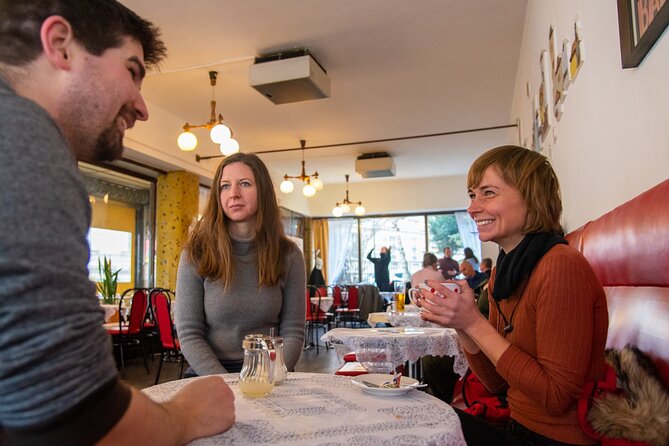
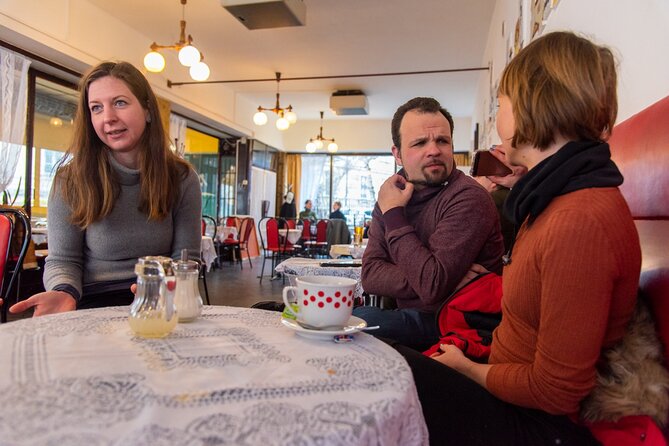
You start at Bambi Café, in Budapest’s 2nd district, at Frankel Leó út 2-4. The best part of starting here is the mood. It has that cult café vibe and has changed close to none since the 1970s, so the setting quietly reinforces the theme: modern Hungary didn’t fall from the sky.
For this kind of experience, the surroundings matter. A political history tour can feel like a lecture. But a café start helps keep the tone human—more like a real conversation with a local than a classroom presentation.
Practical detail: the cafe visit is included in the plan as a meeting point, with admission listed as free. That means you’re not paying extra just to sit down and talk.
The slight drawback is also the nature of the venue: since the focus is talk, you’ll want to be comfortable sitting and listening. If you’re the type who needs motion to feel satisfied on a walking day, plan other sightseeing around this, not during it.
A No-Taboo Hungary conversation, two parts
This experience is built as a conversation with structure. First you get an introduction to Hungary’s recent past and present. Then you get to steer it.
If you have no questions yet, you’re still covered. The host focuses on Hungary’s modern era, mainly over the last 30 years, with an emphasis on historical, economic, and political angles. That initial framework is useful because it gives you anchors for whatever you’re curious about next.
Then comes the part that makes it different from most “history tours.” After the intro, you can ask anything you want about Hungary and go in controversial directions if you want to. That includes questions about changing systems—from communism to democracy—and questions about the idea of “illiberal democracy” that’s been in the conversation in more recent years.
You’ll notice the tour keeps pointing back to present-day life in Budapest and beyond. It’s not only about what changed on paper. It tries to connect the dots to the way people think now, and the way economic pressures and politics show up in daily reality.
This is also why the time works. At about 1 hour 30 minutes, it’s long enough to build context and then test it with your questions. It’s not long enough to wander off-topic forever, which is a good thing.
Communism to democracy, then illiberal democracy
Hungary’s last 30 years are a loaded story, and this tour treats them as such. You’ll hear facts and the host’s opinion on how Hungary moved from communism to democracy—and what has changed in the past few years, including the rise of the term “illiberal democracy.”
Here’s what I think you should watch for: the experience isn’t trying to force one conclusion. It’s more like setting up a high-quality debate stage. You get historical and political context, then you’re allowed to ask hard questions and push for clarity.
That matters because “transition” stories can get oversimplified in travel writing. What this format tries to avoid is the fantasy version where everything improves neatly after the fall of communism. Instead, you’ll get a sense of why people argue about institutions, media, elections, and the direction of the country today.
Also, the tour is honest about the topic being sensitive. The description calls it a no-taboo conversation for a reason. The goal isn’t to shock you. It’s to talk about issues that are hard to discuss politely on a bus tour.
One consideration: if you’re hoping for a purely neutral lecture, this may be slightly opinion-forward at times. That’s not a negative if you want to understand how locals think. It can be frustrating if you’re only comfortable with “just the facts” framing.
Budapest, economy, and the future: what to expect in the questions
After the intro, your curiosity takes over. You can ask about controversial politics, the turbulent past, the economy, and even the uncertain future. In other words, you’re not locked into a single theme like World War II or specific landmarks.
This is where the experience becomes practical for real travel. Political and economic context affects how people experience daily life: confidence, bureaucracy, work, costs, and what people expect from government. You may not need to know every policy detail to benefit from the conversation, but you’ll understand the bigger forces that shape the city you’re walking through.
Budapest itself often gets covered as a postcard: grand buildings, bridges, thermal baths, nightlife. This tour doesn’t ignore that Budapest is attractive. It just adds a layer that usually gets skipped: how modern history and political decisions influence what the city feels like now.
In the open discussion, the host aims to answer questions and tries to handle follow-ups. That’s important. A lot of tours stop at a fixed explanation. Here, you’re actively participating in the meaning.
If you want to make the most of it, come with at least one prompt in mind. For example:
- Why do people support or oppose the current political direction?
- What economic pressures feel most real day-to-day?
- How do the last 30 years still shape Hungarian attitudes today?
You’ll still get the structure even if you show up blank, but having one question helps you start steering immediately.



Small group size, honest answers, and host Daniel’s approach
Maximum group size is six travelers. That small number changes the whole dynamic. You’re less likely to hear half-answers because time ran out. You’re more likely to get follow-up discussion, which is where understanding usually happens.
The host’s approach is framed around honesty and answering your questions. And that shows up in the way people described the experience: one review called it the best experience during a packed week in Budapest, praising how deeply the host could discuss not just Hungary but the wider world. Another described it as ideal if you’ve been to Budapest before and already have some modern history background, and still wanted clarity on today’s situation.
That feedback is consistent with what this tour is designed to do: it’s for people who want to go beyond surface-level facts. The small group setup helps you do that without feeling like you’re taking over a class.
A fun but real point: when the host is willing to answer uncomfortable questions, you stop treating history like a museum exhibit. You start treating it like a living argument that still shapes how people vote, speak, and plan.
Possible drawback again: this is not a silent “look and listen” activity. If you’d rather observe than interact, you may not get the full value of the format.
Price and what you get for $40.52
At $40.52 per person for about 1 hour 30 minutes, this isn’t priced like a “souvenir tour.” It’s priced like a conversation session with a local perspective—plus a setting that supports the theme.
What makes the value feel fair:
- The group is limited to six, so your time with the host isn’t diluted.
- The café meeting point is included with free admission listed for the activity component.
- The content isn’t just a fixed route of sights. It’s a structured intro plus a flexible discussion based on your questions.
Think of it like this: you’re paying for guided context and a back-and-forth exchange. If you’re the type who enjoys asking “why” questions while traveling, it can feel like a bargain. If you prefer passive sightseeing, you might decide to spend that money on something more visual.
Also, the experience includes a mobile ticket. That kind of small friction matters when you’re juggling a busy Budapest itinerary. You won’t need complicated paperwork for a short meetup.
Bottom line: for people who want real context on modern Hungary, $40.52 feels reasonable. For people who want only landmarks, it may feel expensive for a seat at a café.
Practicalities: where to meet and how long it takes
Timing is straightforward. The session starts at 2:00 pm and runs about 1 hour 30 minutes. You meet at Bambi Café, located at Frankel Leó út 2-4, 1027 Hungary, and the experience ends back at the same meeting point.
It’s near public transportation, which helps a lot in Budapest. That way, you can pair this with other plans without needing a car or long detours.
If you’re traveling with a service animal, service animals are allowed. And most travelers can participate, so this isn’t limited to a niche group.
A quick tip for comfort: since the emphasis is conversation, dress for the café environment and bring the kind of energy that works in a calm sit-down setting. Budapest can be a walking city, so this can be a nice rest break—especially if your day includes thermal baths or a long museum visit.
Who this experience fits best (and who might skip it)
This tour fits best if you want to understand modern Hungary beyond the postcard version. It’s especially good for you if:
- You’ve heard terms like communism-to-democracy transition and illiberal democracy, and you want plain explanations.
- You like asking questions rather than collecting photos.
- You’re curious about how politics and economics show up in everyday attitudes.
It also suits you if you’ve already seen a lot of Budapest and want a deeper layer. More than one comment praised it as ideal for repeat visitors who already know the basics but want the contemporary picture.
You might consider skipping it if you:
- Prefer standard guided walking routes with scheduled stops and sightseeing time.
- Don’t want to discuss politics or prefer a strictly neutral presentation.
- Get restless in a seated format.
One more thought: this is maximum six people. That’s intimate, but it also means your comfort with discussion matters. If you’re shy, you can still listen and learn. If you’re worried about controversy, you can steer the questions back to history, economics, or the future rather than confrontational topics.
Should you book Hungary Today: a No-Taboo Conversation?
If you want a real understanding of Hungary in the last 30 years, I think this is a strong pick. The combo of Bambi Café’s 1970s-feel and a two-part conversation gives you context first, then room to ask follow-up questions. The small group size also makes it worth it for your time.
Book it if you’re curious about how a country moves from communism to democracy, what people mean by illiberal democracy, and how current economic and political pressures affect daily life. It’s also a great match if you enjoy talking with locals and want honesty, not just a tidy narrative.
Pass on it if you’re looking for sightseeing calories only, or if you prefer a quiet tour with zero political discussion. In that case, you’ll probably feel like you paid for conversation when you wanted landmarks.
FAQ
What is the location and meeting point?
You’ll meet at Bambi Café, Frankel Leó út 2-4, 1027 Hungary. The experience ends back at the meeting point.
How long is the experience?
It lasts about 1 hour 30 minutes.
How much does it cost?
The price is $40.52 per person.
Is there a mobile ticket?
Yes, the experience uses a mobile ticket.
How big is the group?
The maximum group size is 6 travelers.
What topics will the conversation cover?
You can expect discussion of Hungary’s recent past and present, including the shift from communism to democracy, and the idea of illiberal democracy, along with politics, the economy, and your questions about Hungary and beyond.
Where does the conversation start?
It starts at Bambi Café.
What’s the cancellation policy?
Free cancellation is available up to 24 hours in advance for a full refund.
Are service animals allowed?
Yes, service animals are allowed.
More Tour Reviews in Budapest






Just Added: More Budapest Reviews
- Sightseeing flight over Budapest
★ 5.0 · 3 reviews - Budapest: Walking Tour with Chimney Cake & Polaroid Photos
★ 5.0 · 3 reviews - Self Guided Tour In Budapest With 100 Captivating Audio Stories
★ 5.0 · 3 reviews - Budapest Art Nouveau Walking Tour
★ 5.0 · 3 reviews - Hungary today: a no-taboo conversation
★ 5.0 · 3 reviews