
Reviewed · TUK-TUK & VINTAGE CAR TOURS
Cinematic Virtual Reality City Tour in a Russian Jeep
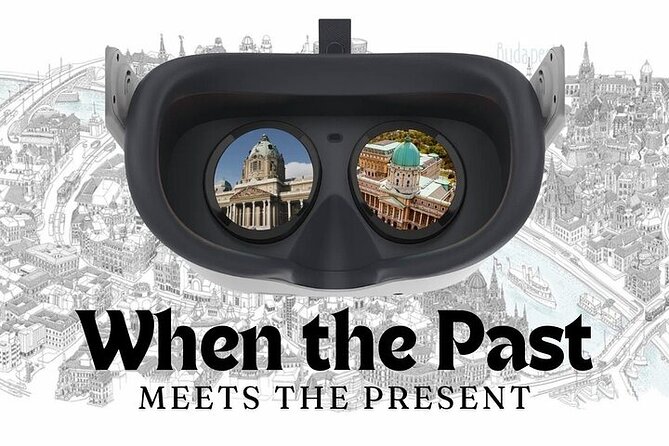
Budapest in a jeep sounds wild, but it works. This cinematic VR city tour pairs a Russian UAZ-style vehicle with headset videos at major sights, so the city feels like a film you can walk around. The best part is how the experience turns familiar stops like Chain Bridge and Buda Castle into clear, time-shifted stories you can place fast.
I like that you get a private, guided route with pickup, plus in-person English guidance while you watch the 2D historical footage. I also like the practicality of included water and hot tea in colder months, so you are not doing the tour thirsty and stressed. The one drawback to plan for: you do not get all indoor tickets included, so Matthias Church and the upper level of Fisherman’s Bastion may cost extra.
In This Review
- Key highlights to know before you go
- A $3 Budapest VR Tour That Feels Like a Movie Date
- How the VR Headsets Change the Landmarks You Think You Know
- Castle Hill to Chain Bridge: the first 30 minutes on wheels
- Matthias Church and Buda Castle: where a little ticket planning helps
- Parliament, St. Stephen’s Basilica, and Andrássy Avenue in one smooth arc
- Opera House, House of Terror, and Heroes’ Square: history with wide emotional range
- Cafe breaks and Danube landmarks: New York Palace, Blaha Lujza, and Erzsébet Bridge
- What’s included, what costs extra, and how to stay comfortable
- Should you book this Cinematic VR Jeep Tour of Budapest?
- FAQ
- How long is the Cinematic Virtual Reality City Tour in Budapest?
- Does the tour include hotel pickup and drop-off?
- Is this a private tour?
- What’s included with the tour besides the guide?
- Is a mobile ticket used?
- Are there VR headsets provided during the stops?
- Is Matthias Church admission included?
- Do I need to pay for Fisherman’s Bastion?
- Does the tour work with an English guide?
- Is the tour suitable for travelers with epilepsy?
- Is free cancellation available?
Key highlights to know before you go
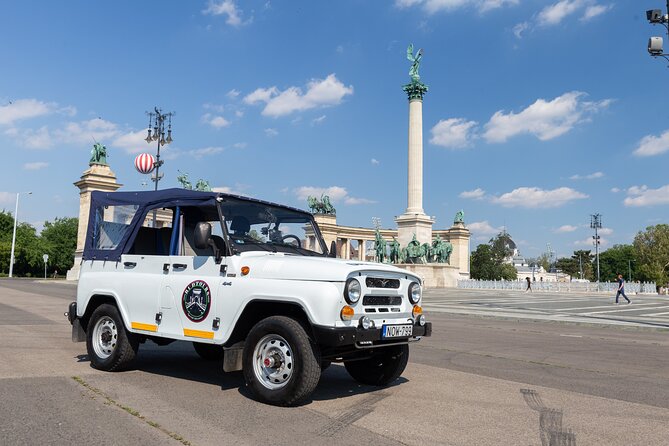
- Russian UAZ-style jeep + hotel pickup for an easy, no-fuss start
- VR headset at multiple landmarks using cinematic 2D videos and audio guidance
- A guide in English with helpful context as you watch and look around
- Most stops are outside and ticket-free, with a couple key exceptions for entry
- Small-group private experience, so you keep your own pacing and questions
The big Budapest sights, gathered into one run
- Budapest: City Highlights Sightseeing Cruise★ 4.6 · 43,981 reviews
- Budapest: City Sightseeing Hop-On Hop-Off Bus Tour & Extras★ 4.1 · 4,337 reviews
- Budapest: Nighttime or Daytime City Sightseeing Cruise★ 4.1 · 2,046 reviews
- Best of Budapest Cruise★ 4.2 · 1,738 reviews
A $3 Budapest VR Tour That Feels Like a Movie Date
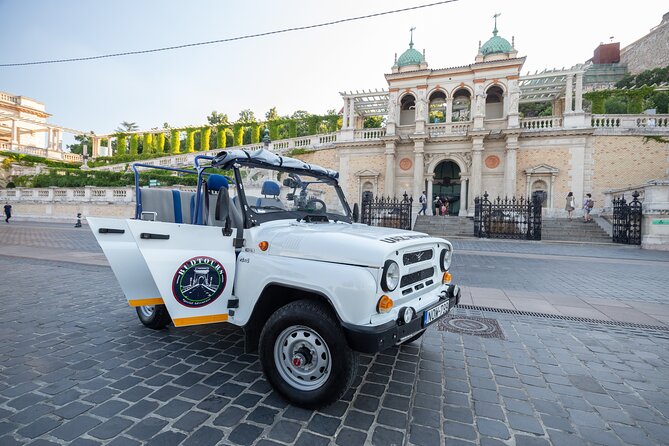
Let’s talk value, because at about $3 for roughly two hours, this is priced like a budget snack, not a guided experience. You are paying for a full package: private transportation, VR gear/headset, a guide, plus pickup and drop-off. That combination is the real bargain, because the cost usually rises fast in Budapest once you add transport and guided time.
Also, the tour format makes sense for a lot of travelers. If you want to see the big-photo landmarks but you do not want to spend your day juggling audio apps, maps, and entry lines, VR can do the heavy lifting. It turns those first-time sights into moments you understand quickly, without needing hours of reading.
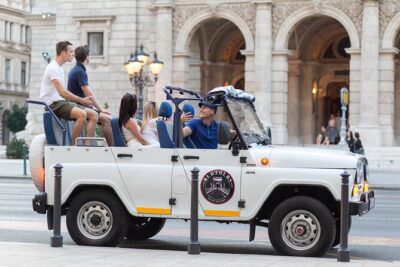
One more value point: the guide element matters here. Headset tours can become a one-way show. In this one, you have an in-person English guide who can explain what you are seeing and answer questions, and that turns the VR from a gimmick into something you can actually use.
How the VR Headsets Change the Landmarks You Think You Know
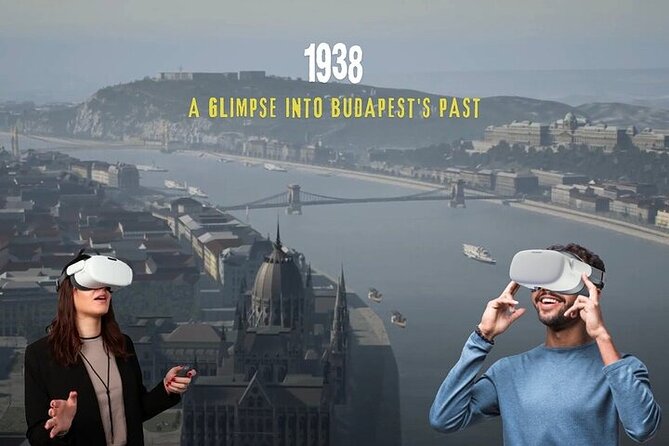
The tour’s core is simple: you stop at a landmark, put on a VR headset, and watch cinematic 2D footage that places you in key moments from Budapest’s past. It is not about slow, detailed walkthroughs of every building. It’s about quick, high-impact context at the places you will recognize in photos and postcards.
You also get audio guidance that mixes historical insight with expert-style commentary. That helps a lot because the city’s center can feel like a blur when you are standing in front of it for the first time. Instead of guessing what matters, the VR framing points you toward the why.
One practical thing: this is not listed as a full walking tour where you roam inside every attraction. Many stops are short—some are 3 to 5 minutes—so the VR moments are meant to give you meaning in a small window. If you like being efficient and moving between sights, you’ll appreciate the structure.
Castle Hill to Chain Bridge: the first 30 minutes on wheels
Your day kicks off at Castle Hill, starting with Castle Garden (Buda Castle Garden Bazaar). This area sits right inside the Buda Castle complex, and it’s known for its mix of exhibitions and concerts and dance shows. Even when there is nothing huge on at that exact moment, it’s the kind of spot where the setting does half the work. The stops are short, so you are not stuck waiting around.
Next comes Széchenyi Chain Bridge, Budapest’s iconic link between Buda and Pest over the Danube. The name is tied to Count István Széchenyi, and the bridge’s history is the focus when you do the VR segment. The payoff here is that VR gives you a time-jump while you are standing in the exact place people associate with modern Budapest.
Then you reach Fisherman’s Bastion for big viewpoints. It looks medieval, but it was built in the early 20th century to mark Hungary’s 1000th birthday. That contrast is a great use case for VR: the footage helps you accept the timeline without feeling like you are being tricked by appearances. Do note the one payment issue: only the upper level of Fisherman’s Bastion requires an admission fee, and that’s specifically called out.
Time planning tip: these first stops are fast. If you like to linger and slowly take in details, you may wish you had more minutes. But if you like the idea of stacking history explanations quickly, the pace is a plus.
Matthias Church and Buda Castle: where a little ticket planning helps
Matthias Church is the standout stop on the religious architecture side. The exterior gets attention, but the listing focuses on the interior’s style blend: an interplay of oriental flair and romantic historicism, topped with Neo-Gothic vibes. The church is one of those places where you can spend time just staring upward, so the VR portion is a good way to add meaning even if you are not doing a full interior visit with every optional detail.
Important: Matthias Church admission is not included. That means you’ll want to decide whether you want to pay to go inside. If you skip the ticket, you can still enjoy the stop and VR context, but you will lose the chance to see the interior design mix up close.
From there, you move into the broader setting of Buda Castle in the Castle Quarter. This is UNESCO World Heritage territory, with a blend of medieval, Baroque, and Neoclassical styles in the surrounding area. The VR part is framed as a way to witness the castle’s grand history come alive while you explore the quarter. This is one of the stops where you get the most value from doing short VR segments at meaningful points, because the area itself can feel like an architectural collage once you’re there.
If your goal is to leave with a mental map, this portion helps you connect buildings and styles to stories, not just images.
Buzz the centre by tuk tuk or a retro ride
Parliament, St. Stephen’s Basilica, and Andrássy Avenue in one smooth arc
After Castle Hill, you shift across the river and into the grand civic and boulevard style of Budapest. You pass the Hungarian Parliament Building on Kossuth Square by the Danube. It’s described as neo-Gothic and noted as Hungary’s largest building since its construction. Since the stop is listed as a pass-by, think of this as a key photo moment plus VR historical context rather than a full interior visit.
Next, you pass or stop around St. Stephen’s Basilica. The information here is about identity and scale: it honors Hungary’s first king, it is the third largest church in Hungary, and it is the tallest in Budapest. World Heritage Site status is also mentioned. Even if you do not go inside, VR framing can help you connect the basilica to its role in the city’s religious and national story.
Then you hit the big boulevard energy of Andrássy Avenue, a UNESCO World Heritage site lined with Neo-Renaissance buildings. The tour notes that it’s also a hub for upscale boutiques, cafés, and restaurants, plus cultural landmarks like the State Opera House and museums. The practical benefit of this stop is that Andrássy Avenue is easier to understand when you have a guided narrative. It’s a straight line of importance, and VR plus audio guidance helps you place what you are seeing in Budapest’s broader story.
If you’re trying to see both architecture and atmosphere without adding extra tickets, this stretch is a strong use of your time.
Opera House, House of Terror, and Heroes’ Square: history with wide emotional range
The tour includes the Hungarian State Opera House. It’s described as a neo-Renaissance treasure with statues of composers on the façade, and the interior is noted for marble sphinxes, frescoes, and gold accents. You get VR context about the opera’s golden age, which makes the stop more than just a pretty exterior photo.
Time is short here—listed as 5 minutes—and the admission is noted as not included, so expect a look and story framing rather than a full opera-house tour. If you want to see grand interiors in detail, you might plan that as a separate add-on later.
One stop with a heavier tone is House of Terror at 60 Andrássy Avenue. The information given is clear about its purpose: a memorial and museum for Hungary’s 20th-century struggles under fascist and communist regimes. It covers imprisonment, interrogation, torture, and deaths. Since the tour lists it as a stop/pass, treat it as a moment on the route rather than a guaranteed deep museum visit during this 2-hour experience. Still, it’s valuable context inside the same day as lighter civic sights.
Then you end the Andrássy Avenue sequence at Heroes’ Square (Hősök tere) near City Park. The star here is the Millennium Monument, with statues of important Hungarian leaders and the Seven Chieftains of the Magyars. It’s a big, open space that makes a perfect counterpoint to the tight, detailed feel of Castle Hill.
If you want your day to include both monumental pride and difficult remembrance, this route gives you that contrast.
Cafe breaks and Danube landmarks: New York Palace, Blaha Lujza, and Erzsébet Bridge
Not every stop is about museums. The tour includes a mention of New York Palace, specifically as a great place for coffee and tea. That matters for real travel life because it gives you a likely spot to pause for a warm drink or a quick break without turning the whole day into a hunt for cafés.
Then you go to Blaha Lujza tér, one of Budapest’s busiest squares. The listing connects it to its cultural past, including that it used to be home to the National Theatre, and it contrasts that past with today’s Corvin Plaza area. Again, VR is used to time-shift the square so you can understand what used to be there.
Next comes Ferenciek Square, described with royal-era hints and a cluster of charming places, including Paris Garden and Klotild Palace. The VR framing is about showing the square in its former glory, so it’s another stop where the headset helps you see beyond what’s currently on the street.
Finally, you have Erzsébet Bridge in VR. The listing says it’s the old bridge from 1903 to 1945, and it calls out construction dates and records: built between 1898 and 1903, it held a world record for 25 years in its category and stayed the Danube record-holder for 70 years. That kind of detail is exactly where VR works. You get a story hook you would never get from a quick glance at modern traffic.
The Danube landmarks are a smart choice for a VR tour, because water views and bridge lines naturally give you “anchors” in the present while the headset shows the past.
What’s included, what costs extra, and how to stay comfortable
Here’s what you get as part of the deal: hotel pickup and drop-off, private transportation, bottled water (and hot tea in winter), plus VR gear/headset. You also have a guide in English and a private feel so you can ask questions.
The key extras are clearly stated: Matthias Church entry is not included, and the upper level of Fisherman’s Bastion requires an admission fee. Everything else on the route is listed as free entry, so you’re mostly paying nothing beyond those two notes.
You also want to consider health and comfort. The tour is not recommended for travelers suffering from epilepsy due to VR. If that applies to you, skip it. If you are generally fine with VR, bring a bit of patience: the stops are short, so you may want to keep your headset adjustments quick so you can stay on pace.
Also, it’s built to be easy for a range of travelers: confirmation is received at booking time, service animals are allowed, and it’s near public transportation. That last detail helps if you need to navigate to/from pickup.
If you’re traveling in a small group or as a family, this private setup can feel calmer than larger hop-on hop-off style tours.
Should you book this Cinematic VR Jeep Tour of Budapest?
Yes, I’d book it if you want a fast, guided way to connect Budapest’s landmarks to their past without building a whole day around museums. The strongest reason is the combo: VR storytelling at real stops plus an English guide plus pickup in a Russian UAZ-style jeep.
Skip it if you want lots of time inside famous buildings. This tour is structured for exterior stops, quick context, and short VR segments. You’ll likely leave wanting more time at one or two places, especially if churches or interior architecture are your top priority.
Best-fit travelers: first-timers, history-curious visitors who like a fun format, families who want a change of pace, and anyone who would rather spend two hours learning the city than spending two hours figuring it out.
FAQ
How long is the Cinematic Virtual Reality City Tour in Budapest?
The tour runs for about 2 hours.
Does the tour include hotel pickup and drop-off?
Yes. Hotel pickup and drop-off are included.
Is this a private tour?
Yes. It’s private, and only your group participates.
What’s included with the tour besides the guide?
Included items are VR gear/headset, bottled water, and in winter hot tea, plus private transportation and an in-person English guide.
Is a mobile ticket used?
Yes, the tour uses a mobile ticket.
Are there VR headsets provided during the stops?
Yes. Virtual Reality gear/headsets are included.
Is Matthias Church admission included?
No. Matthias Church entry is not included.
Do I need to pay for Fisherman’s Bastion?
Only the upper level of Fisherman’s Bastion requires an admission fee.
Does the tour work with an English guide?
Yes. There is an in-person English guide.
Is the tour suitable for travelers with epilepsy?
It is not recommended for travelers suffering from epilepsy.
Is free cancellation available?
Yes. You can cancel for free up to 24 hours in advance for a full refund. If you cancel within 24 hours, the amount paid is not refunded.
More Tour Reviews in Budapest






Budapest by Tuk Tuk and Retro Ride





Budapest in a Single Day




Just Added: More Budapest Reviews
- Sightseeing flight over Budapest
★ 5.0 · 3 reviews - Budapest: Walking Tour with Chimney Cake & Polaroid Photos
★ 5.0 · 3 reviews - Self Guided Tour In Budapest With 100 Captivating Audio Stories
★ 5.0 · 3 reviews - Budapest Art Nouveau Walking Tour
★ 5.0 · 3 reviews - Hungary today: a no-taboo conversation
★ 5.0 · 3 reviews
Tuk-Tuk & Vintage Car Tours, compared.
 ★ 5.0Private Budapest TukTuk Tour: Custom Route, Hotel PickupFrom $991,307 reviews
 ★ 5.0Budapest Private Tuk Tuk Half-Day TourFrom $178606 reviews
 ★ 4.9Private City Tour with a Vintage Russian JeepFrom $318246 reviews
★ 5.0Budapest Private City Tour With a Vintage Russian JeepFrom $261198 reviews
★ 4.9Private City Tour with a Vintage Russian JeepFrom $318246 reviews
★ 5.0Budapest Private City Tour With a Vintage Russian JeepFrom $261198 reviews
 ★ 5.0Sightseeing Tour by Electric TuktukFrom $108146 reviews
 ★ 4.9Scenic Tuk Tuk TourFrom $115143 reviews
 ★ 5.0Budapest Romantic Private Tuk Tuk TourFrom $118142 reviews
 ★ 4.9Iconic Budapest tour with Classic Russian Jeep and G-WagonFrom $312126 reviews
Browse the lists this tour appears in