
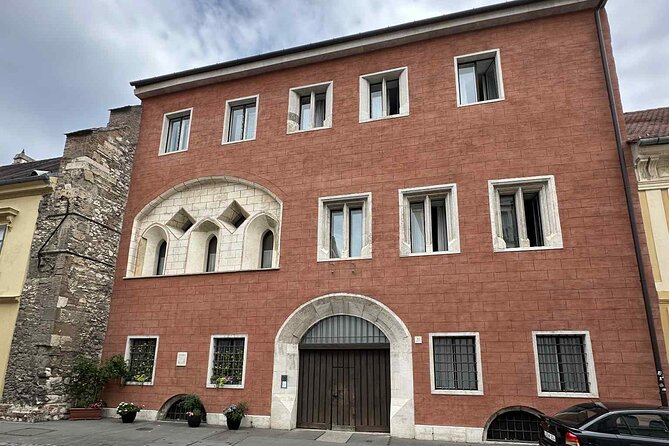
Reviewed · BUDA CASTLE & FISHERMAN'S BASTION
Buda Castle Tour: History and Architecture
Budapest’s castle hill tells stories in layers. This guided route moves from the Royal Palace complex to medieval streets, surviving church towers, and even sites tied to printing and the Siege of 1686—on foot, with real context.
I loved two things most: the way Máté (a historian and archaeologist) explains what you’re actually looking at, and the inclusion of the medieval Jewish prayer house, which makes the day feel more complete than a standard landmark loop.
One consideration: you’ll see major churches and the palace from outside, but no Royal Palace interior, no Matthias Church interior, and no Fisherman’s Bastion upper terrace. If those interiors are your top priority, plan for extra tickets after the tour ends.
In This Review
- Key highlights (what makes it worth your time)
- Where this tour really shines: architecture you can read with your feet
- Royal Palace viewpoints and the palace’s “multiple lives”
- Sigismund’s church foundations: tiny remains with big meaning
- Tárnok Street: medieval commerce under cobblestones
- Úri Street and medieval gateways: noble life at street level
- The Church of Saint Mary Magdalene tower: what survives after demolition
- Országház Street and the Italian merchant story
- The Neo-Gothic finance building: reconstruction with controversy
- Matthias Church from the outside (and why the interior is extra)
- Fortuna Street: printing, a red hedgehog, and a quieter street today
- Becsi Kapu Square and the social life of a medieval entrance
- National Archives: medieval style on purpose
- Siege of 1686 orientation: where walls were breached
- The medieval Jewish quarter: a quiet stop with included entry
- Táncsics Mihály Street: ruins reused instead of erased
- Dominican monastery remains and the Hilton Hotel blend
- Fisherman’s Bastion: what you can see without buying a terrace ticket
- Is the $43.25 price fair? Here’s how I think about value
- Who should book this Buda Castle history-and-architecture walk
- Should you book it?
- FAQ
- How long is the Buda Castle Tour?
- What’s included in the price of $43.25?
- What does the tour not include?
- Is the tour in English?
- Where does the tour start and end?
- Is the Jewish Praying House included every day?
Key highlights (what makes it worth your time)
- Máté’s clear history-to-stone explanations: he connects architectural style changes to specific political and cultural shifts
- Medieval Jewish prayer house included (with closures on Saturday and Monday)
- You walk the real commercial streets: Tárnok Street and Úri Street explain how Buda worked day-to-day
- Siege-of-1686 stop points: you get oriented on the wall-breaches and the Christian liberation story
- Országház and Fortuna street details: Italian merchant life, a rare sgraffito, and Hungary’s first printed book link
More of Castle Hill, turrets and the river below
- Budapest: Buda Castle Cave Tour★ 4.7 · 5,677 reviews
- Budapest: Buda Castle District Vampires and Myths Night Tour★ 4.6 · 3,830 reviews
- Budapest: Buda Castle Walk with Saint Stephen’s Hall★ 4.5 · 3,012 reviews
- Budapest: Buda Castle District Walking Tour★ 4.6 · 2,108 reviews
Where this tour really shines: architecture you can read with your feet
Buda Castle District isn’t just “pretty old buildings.” It’s a big outdoor classroom where stone, street plans, and even missing structures tell you what happened to Hungary over centuries. This tour is built around that idea: you don’t just look at landmarks, you learn how they changed—built, destroyed, rebuilt, repurposed, and sometimes intentionally erased.
What helps most is pacing. The walk is about 3 hours 30 minutes, and the group is capped at 12 people, so you can actually ask questions and keep up. It’s offered in English and uses a mobile ticket, which makes arrival simpler.
You’ll also get a feel for why Buda Castle Hill looks the way it does from street level. Most visitors bounce between viewpoints. Here, you slow down and notice layers: Gothic foundations that stayed in courtyards, Renaissance traces on otherwise older walls, and later Neo-Gothic or Neo-Romanesque buildings styled to match the medieval surroundings.
Royal Palace viewpoints and the palace’s “multiple lives”
You start by focusing on the Royal Palace area—a key reason this tour is popular. The palace wasn’t a single era’s project. It was repeatedly built up, wrecked, and rebuilt as power shifted. That means the building you see today reflects different tastes and pressures rather than one unified plan.
You’ll get orientation on how a medieval stronghold gradually transformed into a royal residence. As you look around, your guide connects architectural elements to the eras they came from—so you don’t just spot styles, you understand why those styles showed up. This matters because Buda Castle District can otherwise feel like random “cool old stuff.” With the explanation, it becomes a story with chapters.
A practical note: the tour includes time at the palace area, but it doesn’t include the Royal Palace interior ticket. If you want to step inside rooms or galleries, treat that as an add-on you can do after the walk.
Sigismund’s church foundations: tiny remains with big meaning
Next comes something easy to miss if you’re sightseeing on your own: the remains of the medieval Sigismund Church. During expansion of the Royal Palace complex in the early 15th century, a Gothic-style royal chapel was constructed, and today you can still see its foundations in the courtyards below.
This stop is short—about 3 minutes—but it’s powerful. It shows you how early royal construction worked: monumental religious space tied directly to the palace’s political ambitions. Even when buildings are gone, foundations still map the “real” shape of history.
Tárnok Street: medieval commerce under cobblestones
Then you step into Tárnok Street, the former burgher town’s main commercial lane beneath the royal court. The vibe shifts here: instead of thinking only about kings and palaces, you start thinking about everyday trade—goods stored, sold, and displayed by ordinary merchants.
This street is cobbled and tightly packed, and that physical feel matters. Your guide points out how some medieval merchant houses held up through fire, siege, and urban change. The point isn’t just that the buildings are old. It’s that daily commerce shaped the street plan and the architecture you’re walking through now.
It’s also a stop that pairs well with photos, because the street compresses perspective. You’ll get a better sense of scale than you would from a wide viewpoint.
Further back into Budapest's past


Úri Street and medieval gateways: noble life at street level
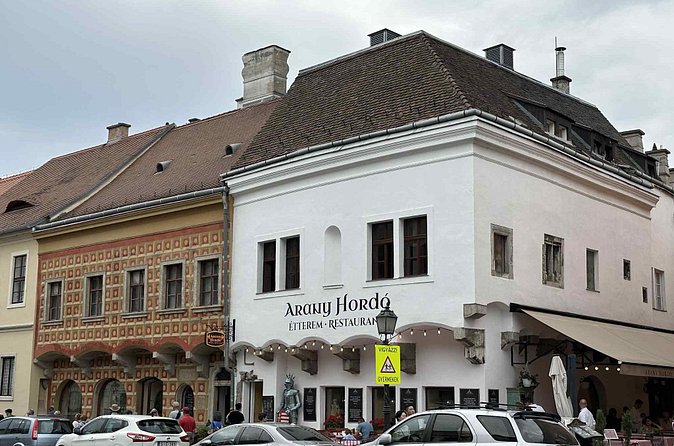
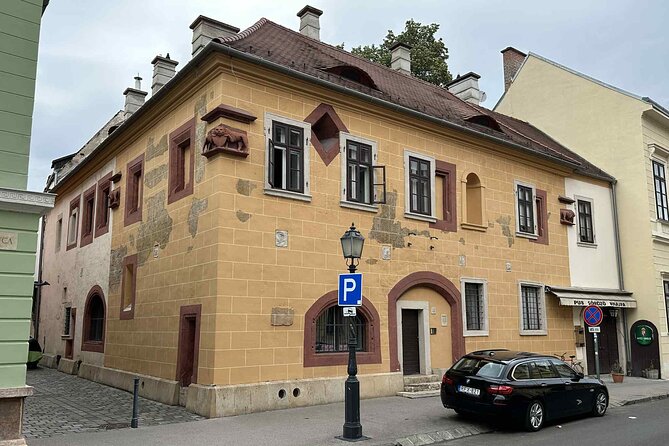
From Tárnok you continue to Úri Street, once the noble residential quarter. This is where the tour balances the day: merchants below, nobles above, and a clear architectural contrast in the details.
You’ll learn about remnants of aristocratic palaces and residential houses built on 14th–15th century foundations. And one of the most enjoyable parts is the focus on medieval gateways—ornate entrances with arches that once welcomed merchants, craftsmen, and travelers. Those doorways and passageways help you imagine movement through the district, not just standing still and looking.
One drawback here is also the nature of the setting: streets are uneven, and you’re outside for a long stretch. Wear shoes that can handle old paving and small changes in elevation.
The Church of Saint Mary Magdalene tower: what survives after demolition
The next stop is the Church of Saint Mary Magdalene, or more precisely, what remains of it. The church sits on the site of an earlier church on Castle Hill, with foundations dating back to the 13th century.
You’ll hear why it mattered to the Hungarian-speaking community and how the siege of Buda in 1686 partially destroyed it. Then comes the modern break: the ruined structure was demolished in the 1950s under Hungary’s communist regime. The one thing that survived is the medieval tower—saved through preservation work.
This stop is listed as about 8 minutes and it lands emotionally. It’s not “spectacle architecture.” It’s memory architecture: a single survivor that makes you think about how quickly history can be lost—and how much effort it takes to keep anything from disappearing.
Országház Street and the Italian merchant story
Next you walk Országház Street, once known as Italian Street in medieval times. Here the story shifts again toward international exchange. The street hosted Italian merchants, and the buildings around you reflect prosperity in the 14th and 15th centuries.
One standout detail is the only surviving 16th-century sgraffito decoration in the entire Castle District. Sgraffito is the kind of surface detail that’s easy to miss if you’re not told what to look for. With your guide’s explanation, you’ll start noticing how Renaissance artistry can show through in unexpected places.
This stop is also a good reminder that Buda wasn’t isolated. Trade and diplomacy brought people together, and the built environment shows it.
The Neo-Gothic finance building: reconstruction with controversy
At Volt Magyar Királyi Pénzügyminisztérium—the neo-Gothic building that today houses Hungary’s Ministry of Finance—you’ll see how much demolition and reconstruction can shape a historic district.
The building was constructed in the early 20th century, requiring the demolition of several medieval structures. It was damaged during World War II, then the façade was simplified afterward. In more recent years, the original façade was reconstructed, restoring much of its grandeur—but the process sparked debate, including the loss of part of a wing during reconstruction.
As an architecture-minded stop, this is useful because it forces a question: when do “restorations” become re-creations? Even if you don’t have opinions yet, you’ll leave with a clearer framework for what you see.
Matthias Church from the outside (and why the interior is extra)
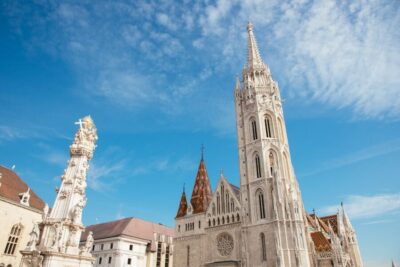
You’ll pass by the Church of the Assumption of the Buda Castle, often incorrectly called Matthias Church. The tour notes the church’s history with Buda’s German-speaking community, and the big takeaway is cultural layers on Castle Hill—not one simple identity.
The tour includes exterior time (about 5 minutes), but entry to the interior isn’t included. That’s a good fit for most people on a walking tour, but if you specifically want the interior experience, plan to purchase tickets after you finish. You’ll end right nearby anyway.
Fortuna Street: printing, a red hedgehog, and a quieter street today
Then comes Fortuna Street, which feels calm now but had aristocratic and townhouse energy in the Middle Ages. This is one of the more distinctive stops because the story links buildings to a turning point: in the 1470s, Andreas Hess—spelled in the description with a German-born printer—produced Hungary’s first printed book, the Chronica Hungarorum.
You’ll also hear about the old Red Hedgehog Inn (Vörös Sün) nearby, described as a legendary meeting point for travelers, merchants, and intellectuals for centuries. Today, you get modern restaurant sounds, which makes the contrast funny in a way: you’re standing in the same kind of place where ideas and people circulated, just with different noise.
Becsi Kapu Square and the social life of a medieval entrance
At Becsi Kapu Square, you shift into a marketplace-and-entry mindset. This square once served as both a trade meeting point and a main entrance to medieval Buda.
The tour connects this place to mixed social life: you’ll hear about interactions between Hungarian townsfolk and the local Jewish community in trade, talk, and worship. The setting today is charming, but your guide helps you imagine what “public space” meant here when people arrived and exchanged news as much as goods.
National Archives: medieval style on purpose
The National Archives of Hungary is early 20th century, designed in a Neo-Romanesque style to echo the medieval character of the Castle District. You’ll notice the heavy stonework and arched windows that make it appear older than it is.
What I like about this stop on a history walk is the explicit purpose. It’s not just architecture for architecture’s sake—it’s meant to symbolically tie national memory to the medieval district. And since archives are about documents, it’s a fitting mood shift if the day so far has focused on stones, walls, and street life.
Siege of 1686 orientation: where walls were breached
As the walk continues along the outer castle walls, you’ll stop near key points from the Siege of Buda in 1686. The tour points out where the walls were first breached by allied forces and where the Ottoman pasha of Buda fell in battle.
It’s a thoughtful moment because it connects the visible walls to an event timeline. Even if you’ve read about the siege before, you’ll get a better sense of location—where the action likely unfolded relative to where you’re standing. A solemn memorial nearby also honors multinational Christian soldiers who fought and died.
The medieval Jewish quarter: a quiet stop with included entry
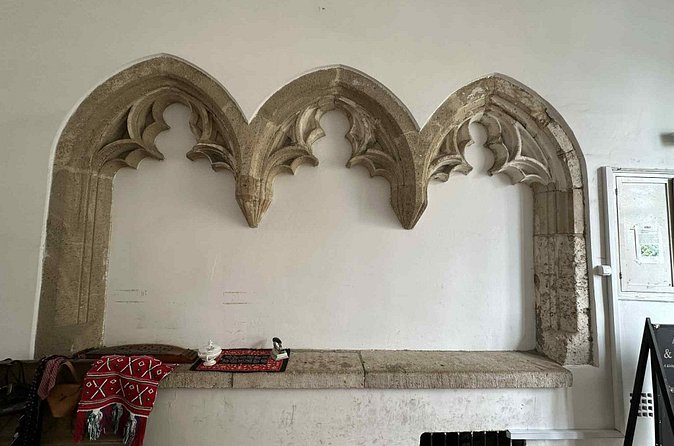
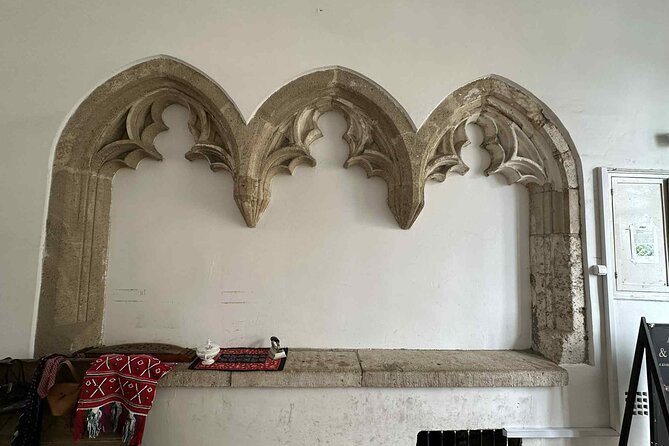
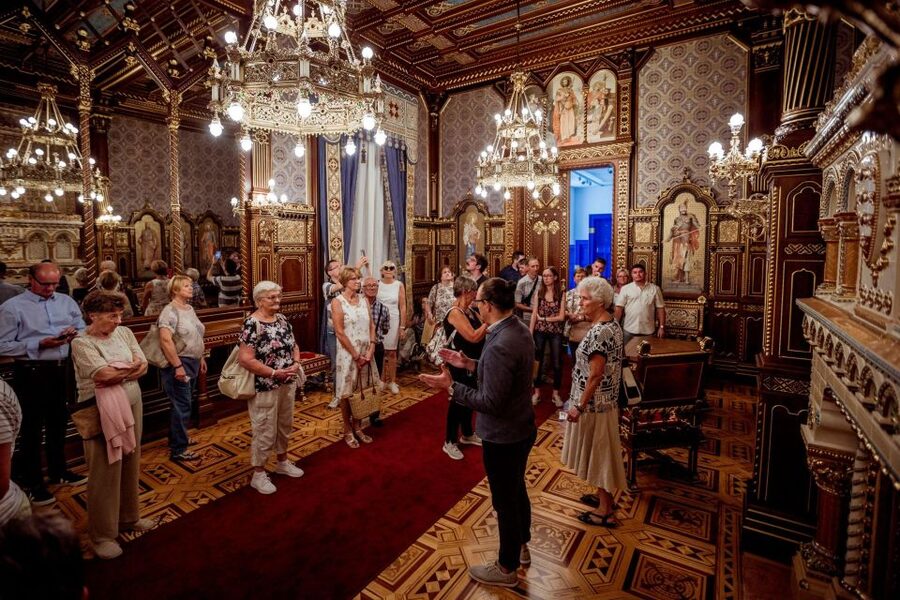
Next you enter the medieval Jewish quarter, and the mood changes. You’ll pause at the site of the former Gothic synagogue, then move to the excavated medieval Jewish prayer house.
This is one of the most meaningful parts of the tour because it’s not only a description of a lost building. It’s an actual surviving structure in an excavated setting. The tour includes the entrance ticket here, labeled as included in the tour price.
Important practical detail: the Jewish praying house is closed on Saturday and Monday. If your visit falls on those days, you’ll want to adjust your expectations or ask your guide how the schedule is handled that day.
Táncsics Mihály Street: ruins reused instead of erased
Then you walk along Táncsics Mihály utca, where the story is about reuse. Instead of demolishing everything after change or conflict, older Gothic walls and cellars were incorporated into later Baroque and 17th–18th century residential buildings.
This is where architecture becomes almost archaeological in your mind. You start spotting seams between eras: why a wall feels thicker, why a doorway or cellar seems older than the façade around it. It’s a reminder that historic cities evolve by layering, not by wiping clean.
Dominican monastery remains and the Hilton Hotel blend
One of the most talked-about contrasts in the district is at Dominikánus Udvar, where you’ll see the remains of the Dominican monastery of Saint Nicholas. The tour links the order to Friar Julianus’s legendary journey in the 13th century.
Then you get to the more modern story: centuries of fire, siege, and neglect—followed by a striking reinterpretation during construction of the Hilton Hotel in the 20th century. The result is a blend of medieval stonework and modern building, and the tour frames it as controversial.
This stop is worth your attention because it shows how preservation can look different depending on what decision-makers prioritize. You’ll likely leave with your own view of the tradeoff.
Fisherman’s Bastion: what you can see without buying a terrace ticket
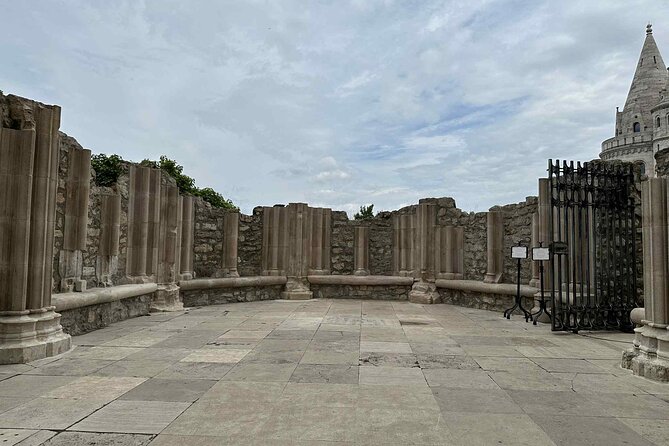
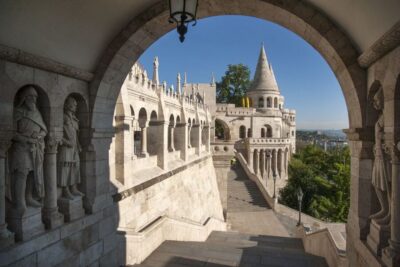
Finally you reach Fisherman’s Bastion, one of Budapest’s most recognizable spots. At its center is the equestrian statue of King Saint Stephen, Hungary’s first Christian king, symbolizing the birth of the Hungarian state.
You’ll admire the monument and the structure from the main level, but you won’t enter the upper panoramic terrace. Access requires a separate ticket that isn’t included in the tour price. This matters because the terrace is the big “look out” draw for many visitors; if that’s your goal, plan the purchase after the tour.
The ending point is Szentháromság Square, right by Matthias Church, so you can easily continue on foot if you want interior access or more photos.
Is the $43.25 price fair? Here’s how I think about value
At $43.25 per person, you’re paying for a guided walk that covers a lot of ground in a single window: 16 stops, plus a licensed English-speaking guide and one included ticket (the medieval Jewish prayer house). You also avoid spending time hunting for context yourself across many different streets and architectural styles.
This can be excellent value if you want to understand what you’re seeing instead of just collecting photos. In particular, the tour’s structure—palace layers, street commerce, siege orientation, and Jewish quarter heritage—creates a coherent “how the city worked and changed” story.
It’s less of a bargain if your main plan is interior sightseeing inside the Royal Palace or Matthias Church, or if you specifically want the Fisherman’s Bastion terrace. Those aren’t included, so you’ll still pay extra if you want them.
Who should book this Buda Castle history-and-architecture walk
This is a strong fit if you:
- like architecture that has explanations attached (styles, foundations, rebuilding choices)
- enjoy walking long enough to feel you’re “in the city,” not just at photo stops
- want a guided route that includes Jewish quarter sites alongside palace landmarks
- appreciate a small group where the guide can answer questions (max 12)
It’s a tougher fit if you:
- have limited mobility, since the tour is marked as not suitable
- want a lot of interior museum time, since Royal Palace and Matthias Church interiors are excluded
- are traveling with kids under 10, since children under 10 aren’t permitted
Should you book it?
I’d book it if your goal is to understand Buda Castle Hill as a living set of layers—royal power above, merchants and nobles in the streets, and a heavy historical story at the walls and in the Jewish quarter. The included medieval Jewish prayer house is a big reason this works better than the common “palace exterior only” versions.
Don’t book it blindly if you only care about interiors or panoramic terraces. You’ll see those key areas from outside, and you’ll need extra tickets for the Royal Palace interior, Matthias Church interior, and the Fisherman’s Bastion upper lookout.
If you can handle a long walking day and want the city explained in plain terms, this is one of the better ways to spend your time on the Buda side.
FAQ
How long is the Buda Castle Tour?
It lasts about 3 hours 30 minutes.
What’s included in the price of $43.25?
The price includes an officially licensed English-speaking guide, a guest pass with lanyard (collected at the end), and the entrance fee to the Jewish Praying House.
What does the tour not include?
It does not include admission to the interior of Matthias Church, access to the upper panoramic terrace of Fisherman’s Bastion, or admission to the interior of the Royal Palace.
Is the tour in English?
Yes, the tour is offered in English.
Where does the tour start and end?
It starts at the Statue of Prince Eugene of Savoy (Budapest, 1013) and ends at Matthias Church, by Szentháromság Square (Mátyás Templom, Szentháromság tér 2, 1014).
Is the Jewish Praying House included every day?
The Jewish Praying House entrance is included, but it is closed on Saturday and Monday.
More Tours in Budapest





More Tour Reviews in Budapest






More of Castle Hill



Just Added: More Budapest Reviews
- Sightseeing flight over Budapest
★ 5.0 · 3 reviews - Budapest: Walking Tour with Chimney Cake & Polaroid Photos
★ 5.0 · 3 reviews - Self Guided Tour In Budapest With 100 Captivating Audio Stories
★ 5.0 · 3 reviews - Budapest Art Nouveau Walking Tour
★ 5.0 · 3 reviews - Hungary today: a no-taboo conversation
★ 5.0 · 3 reviews
Buda Castle & Fisherman's Bastion, compared.
 ★ 4.7Buda Castle Cave TourFrom $195,677 reviews
 ★ 4.6Buda Castle District Vampires and Myths Night TourFrom $233,830 reviews
 ★ 4.6Buda Castle District Walking TourFrom $142,108 reviews
 ★ 4.33-Hour Grand City Tour and Castle WalkFrom $491,437 reviews
 ★ 4.5Buda Castle District Dark History, Legends and Vampire Night TourFrom $211,240 reviews
 ★ 4.9Buda Castle District Walking Tour with a HistorianFrom $63867 reviews
 ★ 4.6Classical Music Concerts in Matthias ChurchFrom $70792 reviews
 ★ 4.6Matthias Church Entry TicketFrom $25787 reviews
Browse the lists this tour appears in