
Reviewed · PHOTOGRAPHY TOURS
Analog Photo Trip
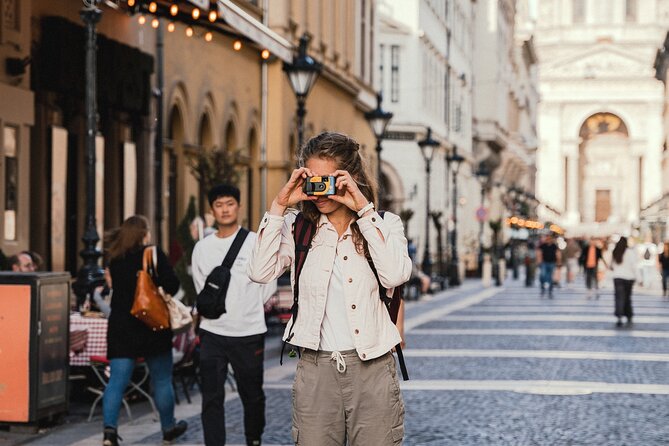
Budapest at 5 pm feels like a photo set. This Analog Photo Trip turns big sights into story shots. You’ll get real-time help using analog cameras, plus a guided thread through the city’s most iconic viewpoints.
What I liked most is the way the tour mixes landmarks with quick history, so you’re not just snapping. I also love the pace: short stops built around what to photograph next, led by Emese Tárnok. The only potential drawback is timing is tight at each location, so if you want long, unhurried hangs, you may wish you had more time on your own.
In This Review
- Key Highlights You Should Care About
- Analog Cameras Make Budapest Feel Different
- Your 5:00 pm Plan: How the Route Flows
- St. Stephen’s Basilica: The Photo-Friendly Start in Downtown Budapest
- Széchenyi Lánchíd and Chain Bridge Views Before Tram 2
- Hungarian Parliament Building and Kossuth Lajos Square
- Margaret Bridge: A View of Your Past and Your Future
- Matthias Church: Quick Time for Gothic Beauty
- Fisherman’s Bastion: Closing the Tour with a Castle District View
- Price and Value: Is $142.97 Worth It?
- Who Should Book This Analog Photo Trip?
- Should You Book This Tour or Skip It?
- FAQ
- FAQ
- How long is the Analog Photo Trip in Budapest?
- What time does the tour start?
- Where do I meet the guide?
- Where does the tour end?
- Is the tour offered in English?
- How big is the group?
- Are there admission fees for the main stops?
- Is there a mobile ticket?
- What’s the cancellation policy?
- Is the tour weather dependent?
- Are service animals allowed?
Key Highlights You Should Care About
- Small group size (max 12): you get room to ask questions and not feel rushed.
- Analog camera coaching included: you’ll learn the basics while you’re actually out shooting.
- Iconic Budapest views, efficiently grouped: Basilica, Chain Bridge area, Parliament, and the Castle District.
- Stroll-to-photo timing at river crossings: Margaret Bridge gives you perspective on where you’ve been and what’s next.
- English-speaking guide: the trip is offered in English.
- Free-entry stop notes: each listed main stop is marked with admission ticket free.
A photographer to catch you against Budapest
- Private photography photo session at Fisherman Bastion★ 5.0 · 269 reviews
- Budapest photoshoot&sightseeing★ 5.0 · 107 reviews
- Budapest: Walking Tour and Photoshoot with Digital Photos★ 4.7 · 82 reviews
- Budapest: Vacation Photographer to collect great memories★ 5.0 · 49 reviews
Analog Cameras Make Budapest Feel Different
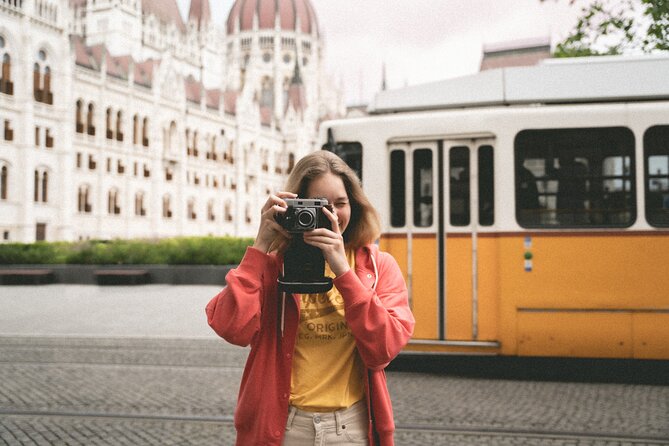
There’s something about analog photography that slows you down in a good way. In Budapest, where you can easily over-snap a hundred digital photos in a minute, analog nudges you to choose your frames. That choice makes the city look more intentional.
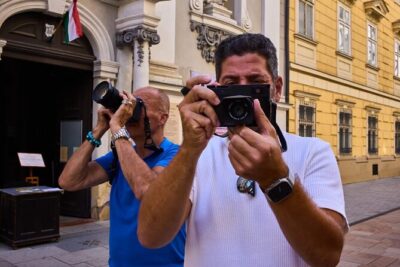
On this tour, you don’t just hear facts while you walk. You’re also learning how to use the analog cameras along the route. That changes the whole experience: instead of sightseeing in the normal way, you’re hunting angles and practicing patience. You end up with physical photos as souvenirs, which is a nice change from the usual phone-only “I was there” proof.
Another big win is that the guide connects architecture to place. You’ll look at St. Stephen’s Basilica, then move to the river-and-bridge viewpoints, then to Hungary’s political centerpiece, and finally into the Castle District. The result is a route that builds momentum. Even if some stops feel short, you’ll understand why each one matters and how to photograph it.
A quick note before you commit: this is designed for a group walk with frequent brief stops. So if you want to read every plaque for 30 minutes, you may feel a little pressed.
Your 5:00 pm Plan: How the Route Flows
The tour starts at 5:00 pm and runs about 3 hours 30 minutes. You meet at CBI CompareBudapest, Anker köz 2-4, 1061 Hungary, and you finish at Fisherman’s Bastion, 1014 Hungary. If you like finishing your evening with a strong viewpoint, that ending is a win.
It’s also a smart time of day for photos. Late afternoon and early evening light can soften glare and make stone buildings look warmer. You’re not stuck waiting for perfect weather all day—you’re actually out using the light you get.
The group limit matters too. With a maximum of 12 travelers, the guide can keep things moving while still giving people attention when they need it. That’s especially helpful when you’re learning a camera method that’s new to you.
You’ll also be walking through areas that are easy to reach via public transit, and the trip notes that it’s near public transportation. Service animals are allowed, and most people can participate, so it’s broadly approachable.
St. Stephen’s Basilica: The Photo-Friendly Start in Downtown Budapest
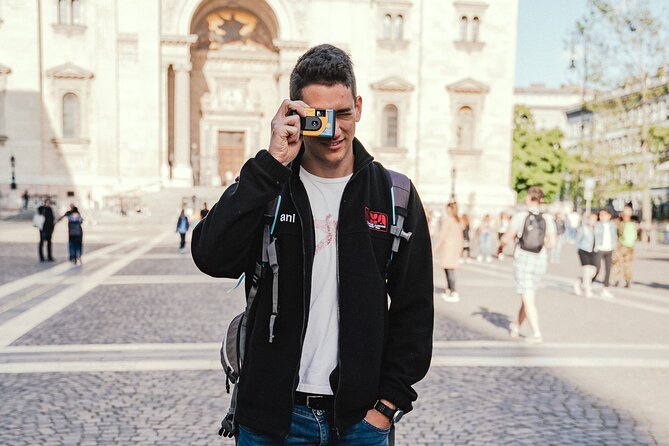
Your first stop is St. Stephen’s Basilica (Szent Istvan Bazilika). The time here is brief—about 15 minutes—but it’s a strong opener because it sets the visual and historical tone.
This church is often seen as a centerpiece for Hungarian identity, and the tour uses that idea to help you look differently. You’ll “look around and learn about the history” of Hungary’s most important church. In practice, that means you’re not just capturing the exterior—your guide helps you understand what you’re seeing and how the building fits into the city’s story.
From a photography standpoint, early in the tour is a good moment to get your bearings. Your hands will still be fresh from the start time, and you’ll be warmed up for how the analog camera approach changes your framing. If you’ve never used an analog camera before, this first stop is a good training ground: you can test settings and composition without feeling like you’re wasting the best photo light of the day.
Possible consideration: because the stop is short, come with a plan of what you want (wide shot vs. detail shot), not an expectation of endless time inside or around every corner.
Széchenyi Lánchíd and Chain Bridge Views Before Tram 2
Next you’ll head toward Szechenyi Lanchid, and you’ll do something practical right before the route continues: you’ll capture a view of the Chain bridge with Buda Castle in the background, before you head on using Tram 2.
That’s a clever setup. This isn’t just “walk and point.” You’re given a real shot target: the bridge view with the castle behind it. It’s exactly the kind of composition analog photography rewards, because you’re forced to choose one strong angle rather than scatter attention everywhere.
Why I like this moment on the tour is that it bridges (pun fully intended) the “church and city” feeling of the first stop with the “politics and river” feeling of what comes next. You’re also moving toward a section of Budapest that’s visually layered. The Danube separates the story you’ve just started from the story you’re about to enter.
You’ll spend about 15 minutes here, and the stop is marked with free admission ticket as well. So you’re not paying extra to enjoy the time—your attention stays on the view and the camera lesson.
Small reality check: Tram timing can add a bit of motion and noise around you. That’s normal for a city transit moment, and it’s also a good reminder that street photography often means dealing with people moving through your frame.


Hungarian Parliament Building and Kossuth Lajos Square
The tour then shifts to one of Budapest’s most recognizable modern icons: the Hungarian Parliament Building. Your time here is again about 15 minutes, focused on the surroundings of Kossuth Lajos square and the history of the place.
For photography, Parliament has strong geometry. It’s the kind of building where you’ll want straight lines, good reflections if the weather cooperates, and enough time to position yourself so the façade doesn’t look cramped. Because the tour is guided, you’re also learning what to notice—why this space matters, and how the setting connects to Hungary’s broader narrative.
This is also where the tour’s pacing really matters. A fast stop can feel limiting, but it’s not random. It’s planned so you don’t end up exhausted too early. And since you’ve already started learning analog camera handling, you’re more likely to make intentional frames by now.
One more practical point: you’ll keep moving through key sightseeing zones without getting stuck in long waits. If you like seeing the big highlights but hate spending your whole day in line-heavy routines, this structure makes sense.
Margaret Bridge: A View of Your Past and Your Future
At Margaret Bridge, the tour gives you a moment that feels like a reset. You’ll be able to get an unique view of the places you came from and the places you have ahead of you during the Analog Photo Trip.
This is one of the smartest parts of the route because it changes your perspective. Instead of treating Budapest as separate postcards, you see it as a connected walk of vantage points. That makes everything after this feel more coherent.
You’ll spend about 15 minutes here, and this stop also supports the analog style. Bridges are great for shooting because they naturally create lines that pull your eye. And in an analog workflow, those lines help you decide what matters.
If you’ve been too busy chasing “the perfect” shot, this is the place where you can slow your thinking. Use the view to plan. Ask yourself: what story does your camera want to tell next?
Matthias Church: Quick Time for Gothic Beauty
Your penultimate highlight before the final district is Matthias Church. Time is short—about 5 minutes—but the stop is focused on capturing the church’s astonishing Gothic beauty.
Five minutes sounds like nothing. But in a tour like this, short can be good. You’ll likely be arriving with a stronger sense of framing from the earlier analog practice. So instead of starting from scratch, you can work quickly: wide shot first, then a detail if time allows.
This is also a moment where the guide’s advice matters. When you’re using an unfamiliar camera method, someone pointing out a good angle or telling you what to watch for can save you from wasting your best frames.
Consideration: if you want a long look at Matthias Church, you’ll probably want to return later on your own. This tour is built to introduce and photograph, not to replace a full independent visit.
Fisherman’s Bastion: Closing the Tour with a Castle District View
The final stop is Fisherman’s Bastion, inside the Castle District. You’ll spend about 15 minutes here, and you’ll look around the Bastion which was inspired by early medieval architectural style.
This ending choice makes sense. The Castle District viewpoints are exactly what people come to Budapest for, and finishing here gives your photos a strong payoff. Plus, Fisherman’s Bastion is naturally photogenic, which helps when your time is limited and your camera choices matter.
The tour’s structure means you’ll arrive having already shot several key city layers: Basilica first, bridge views, Parliament, then a midpoint bridge perspective, then Matthias Church. So now the camera has a narrative built into it. Your final frames don’t feel random; they feel like the last chapter.
Also, the finish point is clear: you end at Fisherman’s Bastion, so you’re not dealing with late return logistics as part of the experience.
Price and Value: Is $142.97 Worth It?
At $142.97 per person, this is not a bargain-basement walking tour. But it’s also not overpriced for what you’re getting.
Here’s what you’re paying for, in plain terms:
- A focused route across major landmarks in about 3.5 hours
- An English-speaking guide who stays with you through the stops
- Analog camera instruction, which is the main differentiator versus a standard highlights tour
- A small group size (max 12), which makes the experience feel more hands-on
- The stops are marked with free admission ticket in the tour plan, so you’re not stacking attraction fees on top
If you care about the final artifact—physical photos you keep—this can feel like better value than a typical “photos, but only in your phone” sightseeing outing. If analog is new to you, the coaching also reduces the learning curve, so you spend your time shooting instead of fumbling.
On the other hand, if you already know you’ll want lots of extra time at one site, you may prefer a self-paced visit. In a guided analog format, the experience is time-boxed on purpose.
Who Should Book This Analog Photo Trip?
This tour fits best if you:
- Want a guided Budapest highlights route with a creative twist
- Like learning a skill while you travel, not just listening to a lecture
- Prefer smaller groups and short, frequent stops
- Want physical photos as souvenirs and enjoy the idea of taking fewer, stronger shots
It can also work well for couples or small groups because the pacing stays social without getting crowded.
If you’re the type who wants long museum-style time, you might find the stop lengths too short. But if your goal is to capture key sights efficiently and learn something new, you’re in the right place.
Should You Book This Tour or Skip It?
I’d book it if you want Budapest photography with structure and coaching. The combination of major sights—St. Stephen’s Basilica, Chain Bridge views, Parliament, Margaret Bridge, Matthias Church, and Fisherman’s Bastion—plus analog camera instruction is a strong match for anyone who likes planning their time and coming home with something tangible.
I’d skip it if you only want the longest possible time at a single landmark, or if analog photography doesn’t interest you at all. This is about making photos, not just collecting steps.
If the weather cooperates, the timing also makes sense. You’re starting at 5:00 pm, moving through the evening, and ending at a viewpoint that rewards the final frames.
FAQ
FAQ
How long is the Analog Photo Trip in Budapest?
It runs for approximately 3 hours 30 minutes.
What time does the tour start?
The start time is 5:00 pm.
Where do I meet the guide?
You meet at CBI CompareBudapest, Anker köz 2-4, 1061 Hungary.
Where does the tour end?
The tour ends at Fisherman’s Bastion, Budapest, 1014 Hungary.
Is the tour offered in English?
Yes, it’s offered in English.
How big is the group?
The tour has a maximum of 12 travelers.
Are there admission fees for the main stops?
The stop notes indicate admission ticket free for the listed locations.
Is there a mobile ticket?
Yes, the tour includes a mobile ticket.
What’s the cancellation policy?
You can cancel for a full refund up to 24 hours in advance of the experience start time.
Is the tour weather dependent?
Yes. It requires good weather. If it’s canceled due to poor weather, you’ll be offered a different date or a full refund.
Are service animals allowed?
Yes, service animals are allowed.
More Tour Reviews in Budapest



Budapest, Better Framed


Just Added: More Budapest Reviews
- Sightseeing flight over Budapest
★ 5.0 · 3 reviews - Budapest: Walking Tour with Chimney Cake & Polaroid Photos
★ 5.0 · 3 reviews - Self Guided Tour In Budapest With 100 Captivating Audio Stories
★ 5.0 · 3 reviews - Budapest Art Nouveau Walking Tour
★ 5.0 · 3 reviews - Hungary today: a no-taboo conversation
★ 5.0 · 3 reviews
Photography Tours, compared.
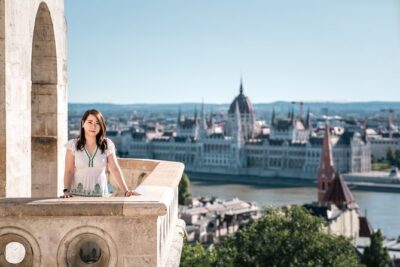 ★ 5.0Private photography photo session at Fisherman BastionFrom $45269 reviews
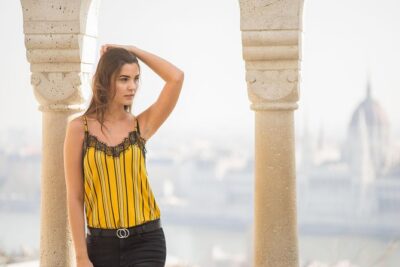 ★ 5.0Budapest photoshoot&sightseeingFrom $114107 reviews
 ★ 4.7Walking Tour and Photoshoot with Digital PhotosFrom $7782 reviews
 ★ 5.0Vacation Photographer to collect great memoriesFrom $11849 reviews
 ★ 5.0Budapest Photo WalksFrom $17936 reviews
 ★ 5.0Budapest Private Guided Tour with Photoshoot – Big(3hrs)From $12633 reviews
 ★ 5.0Budapest Street Photography by Lukacs GaborFrom $15630 reviews
 ★ 5.0Street photography with your smartphone, tour of BudapestFrom $1626 reviews
Browse the lists this tour appears in